
 Think of something you’re enthusiastic about.
Maybe it’s the environment or animal rights. For some people, it’s a hobby like photography or cooking.
Now imagine being able to generate real income by doing what makes you happy.
That’s everyone’s dream, right?
I’ve read countless stories about midlife people who changed careers and started their own businesses. They found real success and were able to quit their 9 to 5 jobs. Since I enjoy writing and already have a blog I decided to try to turn my hobby into income.
Since I enjoy writing and already have a blog I decided to turn my hobby into income.
However, I had to make some changes to the blog and brush up on certain types of writing. So, I researched and turned up many different websites and resources selling just that type of help.
Aside from offering high-quality training and support, I needed something that wouldn’t break my budget.
Which is why I subscribed to The Freelance Writer’s Den.

One of the first items I utilized in “the Den” was a Boot camp entitled How To Become a Well-Paid Blogger.
Carol Tice, the creator of the Freelance Writers Den, leads these discussions, which often include another industry pro.
The Boot camps are actually webinars that cover a wide variety of topics from How To Create a Writer Website to Self-Publishing 101 (and everything in between!) The video and audio recordings are downloadable and include a Transcript and a Quick Tips. This is incredibly helpful and eliminates the need to take notes.
This Boot camp was very informative and I learned some beneficial concepts. Carol hosts it with Annabel Candy of Successful Blogging. It’s divided into four one-hour sessions that include the following:
Session One
Session Two
Session Three
Session Four
Carol and her co-presenter cover the topics in detail and give helpful examples. At the conclusion of each session, there is a brief Q & A with continuing discussions in the Forum.
This one Boot camp could easily cost several hundred dollars. Instead, I get six months of membership for that price and access to a ton of resources: webinars, podcasts, live training & meetings, and participation in the forum. There’s also a “junk-free” job board. Carol knows from experience that many freelancers work for low wages, so she only accepts clients that pay well.
Regardless of the niche, bloggers are turning their hobby into profits. There’s a formula to reaching success: top notch writing, good quality visuals, and delivering what the consumer needs and wants.
Anyone willing to follow it and work hard can earn substantial income by doing what makes them happy!
The Den is only open several times a year and they’ll begin accepting new members on March 21st (next week).
As a monthly subscription, there is no long-term commitment; maybe now is the time to check it out. Just click on the banner below to take a look.

NOTE: I wrote this after viewing the Edge of Humanity Magazine’s post on March 6. The title is The Faces of Alzheimer’s Disease, a contribution of portrait photography by Alex ten Napel. Please take a few moments to view the images here.

If you’ve ever spent time in an Alzheimer’s/Dementia unit then these faces should look familiar.
Not the individuals themselves, but their expressions and the moods they reflect. These faces range from thoughtful and smiling to frustrated and expressionless. They’re like the ones we all display at various times.
The difference is that ours are prompted by clear thoughts and emotions, triggered by specific circumstances. An Alzheimer’s patient often can’t account for what they’re thinking and feeling at any given moment.
The folks looking thoughtful may actually be unable to focus, their minds overrun with many simultaneous thoughts. They quietly struggle to locate memories or ideas.
Those who are smiling with amusement sometimes do so for no apparent reason. At times they’ll burst into giddy laughter as if they’re privy to some joke that no one else knows.
Then there are the angry, frustrated episodes as the patient lashes out with rage and profanity at everyone around them.
A blank stare can indicate that the person has momentarily disappeared deeper into the fog that is gradually taking over their conscious mind.
The unpredictability of these mood swings is unnerving for family and friends who are slowly watching their loved one slip away.
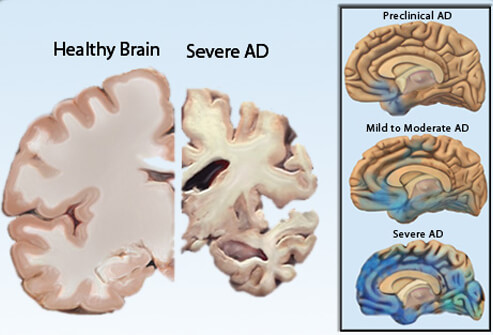
Alzheimer’s is a progressive, neurodegenerative disease that destroys healthy brain cells. The symptoms worsen over time and a person can suffer with it from four to eight years on average. Depending on the circumstances, life expectancy may last up to twenty years after diagnosis.
 Changes in the brain begin to occur years before any symptoms present themselves. This is referred to as the “preclinical” period.
Looking back, I recall times when my dad behaved oddly or had difficulty doing a task that he’d done a hundred times before.
He took medications for high blood pressure, cholesterol, and diabetes, but we weren’t aware of the changes occurring in his brain.
I don’t know if the doctors warned him about dementia as a possible outcome of his other conditions. If they did he chose not to share that information with our family.
In the earliest stages of the disease, the person is still able to function independently. They continue their normal routines with only slight lapses of memory and minor confusion. There can be physical signs, as well. Family members may begin to notice these difficulties. A trained physician can detect problems with concentration and memory through a detailed exam. Likewise, physical exams often expose changes in gait and balance.
This is the stage that typically lasts the longest, sometimes for years. Symptoms, both mental and physical, become much more obvious and the loved one requires a greater level of care. The confusion and disorientation that begins in the middle stage influences the person’s perception of reality.
They also experience communication problems. At times they have difficulty expressing their thoughts and feelings and can’t understand what others are saying. They struggle to remember the meanings of words. This level of disorientation creates fear, anger, and embarrassment.
Patients in this stage require full-time assistance with daily activities and personal care. They have difficulty communicating and lose awareness of their surroundings. They no longer recognize familiar faces. Their physical condition worsens along with their mental state.
It’s important to become familiar with these stages so that caretakers can understand what the patient is experiencing.
Despite the ongoing challenges, there are strategies available to handle these problems. Marie Marley has authored two books and numerous articles on ways to deal with the behavioral issues of dementia patients. In the past, she has focused specifically on the very difficult job of being a caretaker.
However, after reading The Best Friends Approach to Alzheimer’s Care Marley realized that she’d never considered how the patient feels. The book, written by Virginia Bell and David Troxel, explains it in a way that the reader can experience those feelings.
In Marley’s post, she gives an example from the book that really drives this point home. The authors remind the reader of how it felt to be called on in class and not know the correct answer. Then they point out that life for an Alzheimer’s patient is living in that classroom every day and never having the correct answer.
Education is the key to understanding how the illness affects the patient both mentally and physically, and how to manage their care more effectively.
The Alzheimer’s Association is an excellent starting point for your research. They are the leading voluntary health organization committed to caring, support, and research for Alzheimer’s/Dementia patients and their families.
Because there is no cure, Alzheimer’s eventually renders the person completely dependent and powerless.
But, knowledge is power and being able to provide compassionate and informed care is something that benefits both patient and caretaker.
It is also the best and final gift we can offer our loved one.
 Following Seas
You must be logged in to post a comment.