Week 30: After (the workout)


Photo credit: Romain Vignes/Unsplash
Many years ago, when I was in elementary school, a teacher asked the class to name something that we had “alot of” in our homes. It was during an open discussion where we would offer our thoughts about different topics. One classmate said furniture, another one mentioned pets, still another bragged toys. There were a variety of answers, the most amusing being ants. Apparently, a recently spilled pitcher of Kool-Aid in Michael’s kitchen had attracted an army of the tiny, six-legged critters.
My contribution came to mind immediately; books. All kinds of books. Hardcover and paperbacks, both fiction and nonfiction. Then there were dictionaries (English and German), a set of encyclopedias, and a thesaurus. Crossword puzzle books, the local newspaper, TV Guides, and an assortment of magazines that made cooking and home care less tedious for the lady of the house (it was the early ’70s.)

And then there were the Reader’s Digests. In my mind they were in a class of their own. The convenient size fit comfortably in one hand and the table of contents on the cover was nothing short of genius! I could scan the articles on the way back from the mailbox without ever turning a page. Titles, such as “Are UFOs For Real” and “I Am Joe’s Tongue,” readily grabbed my attention.
Then there were the regular features: All in a Day’s Work, Toward More Picturesque Speech, and my all time favorites Quotable Quotes and It Pays to Enrich your Word Power. I believe my enduring fondness for quotes began with the Reader’s Digest. I was also fascinated by the words that appeared on the Word Power page. I had never seen or heard most of them and wondered who on earth actually used them. They sounded foreign and were often lengthy (but not always.) The pronunciations were difficult. Of course, I was ten years old, so my repertoire was much smaller then. I recall thinking how intelligent I would sound if only I could memorize some of these impressive-sounding words.
Eventually, we stopped getting Reader’s Digest and the TV Guide. Mom was cutting back on her subscriptions and there was a special channel that listed the programming lineups. I had also reached an age where it was more important to impress people with clothes and hairstyles versus my command of the English language. Fortunately, I never lost my love of reading and continued to do so, not to enhance my vocabulary, but to entertain myself.
I was excited to discover a website that offers another way to build one’s vocabulary. Wordsmith.org offers a variety of things, among them A.Word.A.Day. This is a link where you can sign up to receive a new word each day, complete with pronunciation, meaning, etymology, and usage. I don’t have to remember usernames or passwords and they come to me. How much easier can it get? The nerd in me even started a spreadsheet!
I’m happy to share this information with you in case you’d like to check it out. It’s a “plain jane” site in terms of visuals, but hey,…their business is words, not photos. You can read about how the site was started and other features they offer. I also added the link to the sidebar here on my blog, just under Recent Posts.
I sometimes think we forget the power of words. In times of pain and sorrow they can bring a measure of comfort. In happy times we seek just the right combination to toast a celebration. They can be used as weapons to discredit and hurt others. Or, as a way to characterize the best qualities a person has to offer.
Whatever the circumstances, we need to choose them wisely. It’s important to remember and respect the potential they carry to do good or to do harm.
And in making our word choices we should also remember that “heterogeneity is the piquancy of life!”

What exactly is “mindful living” and how can it improve the quality of our lives?
During the Kindness Challenge I wrote about zen master and peace activist Thich Nhat Hahn, the Vietnamese Buddhist monk that spent his life teaching the art of mindful living.
He points out that the capacity to enjoy peace matters more than simply having the peace itself. Peace takes many forms, occurs daily, and comes to us through the senses:
Most of the time they’re small things, but there are so many. If we’re not conscious of them, how can we possibly appreciate them?
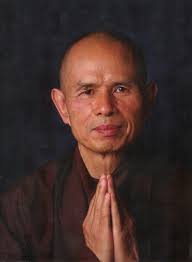
Thich teaches that the practice of meditation and mindful living enables us to have that capacity. We are better able to recognize the beauty that surround us everyday. If we don’t live mindfully we become easily distracted and miss the joyful opportunities in our lives.
He illustrates this point with the story of the “non-toothache.” Most days we wake up without the pain of a toothache (or some other ailment) and that’s a wonderful thing. However, we don’t realize it’s a wonderful thing until we wake up with a toothache. Only then do we understand how lucky we’ve been; enjoying good health for all those other days. We’re reminded that NOT having a toothache is pretty great! Having good health is a true gift, yet we don’t acknowledge it very often. Like so many things, we take it for granted.
So, how do we enjoy peace in the present moment?
Thich instructs us to begin with the sutra (text/scripture) of conscious breathing. This simple exercise consists of breathing in and breathing out. Inhale, exhale.
He tells us that saying or calling something by its name is an important part of mindfulness and makes that particular thing become more real. This aids in concentration and helps focus our attention on breathing and off other things. Thich advises us to silently say “in” and “out” as we breathe in and out.
This act of conscious breathing stops our thinking and gives the mind a rest (and who doesn’t need that a few times a day?) We have a tendency to immerse ourselves in the daily distractions and forget the blessings that we enjoy. Except that we forget to enjoy them.
I was prompted to write this post after receiving some troubling news from home. We all face occasional problems and unhappiness in our lives. Some people deal with far more than others. Often, these issues concern our past. Whatever the case, it’s easy to get caught up in the anxiety of the moment. We become preoccupied with the issue and that can magnify the negative aspects, as well as our angst.

When we become overwhelmed with our sorrows we catastrophize and lose our focus. The molehill quickly becomes a mountain. We can no longer see the goodness that surrounds us.
Thich reminds us that we have the seeds of joy in us; planted many years ago as children. If we don’t practice mindful living, we lose touch with these seeds.
Instead of thinking about what is wrong, we have to also consider what is NOT wrong.
Mindful living helps us keep things in a realistic perspective. Reality is easier to deal with compared to the overblown phantoms we create in our minds. Try the conscious breathing exercise; it will give your mind a break and help you see the whole picture, not just a small section.


You must be logged in to post a comment.