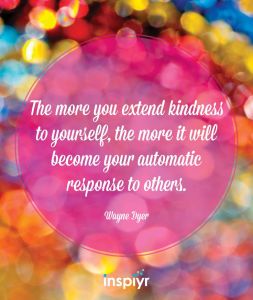
As we moved through week 3 of the Kindness Challenge our goal was to radiate kindness. This is easy to do when things are going smoothly and just the way we want. Smiles and a happy outlook are effortless under ideal conditions.
But, how about when everything goes wrong? You know…those days when we wish we had stayed in bed. It feels like a dark cloud is hanging over our heads and nothing is working out the way we hoped.
At these times the only thing we radiate is anger or frustration. Some of that is directed outward at other people and circumstances beyond our control. The weather, the unexpected traffic jam, the cranky boss. These types of issues can certainly put a damper on our plans and/or spirits.
This irritation is made worse if we start to blame ourselves:
“I should’ve been prepared for the change in weather.”
“I could’ve left earlier to allow for a possible traffic delay.”
” I would’ve worked harder on the last project, if only the boss were more appreciative.”
Should’ve, could’ve and would’ve.
If we make it a habit to constantly criticize ourselves when the going gets tough, we sure won’t be tolerant of others. During Week #1 we were asked to focus on self-kindness. Directing kindness internally must be an everyday practice if we want to show it outwardly.
I used to be quite hard on myself, largely due to the circumstances that I lived under. I blamed myself when things didn’t go right, convinced that I could’ve made a difference if only I were smarter, faster, tougher, etc. Certainly, there were times when I dropped the ball (like most human beings), but I was taking responsibility for things that were out of my control. Eventually, I left a bad situation and began to educate myself about the importance of self-compassion.
As I began to treat myself with love and patience, I was able to accept my humanity. Being human means occasionally making mistakes and I learned to be okay with that. I also noticed that I was more tolerant of others. Things that used to upset me no longer had the negative effects that they once had.
This past week one of my children made a snarky comment and I was able to let it roll right off. My response was a smile and a good-natured, “Oh, no that’s not what I meant…” and I explained in further detail my point. Ten minutes later I got an apology.
It’s so empowering to be more in control of my own emotions. How great if feels when someone is mean-spirited and I’m able to say to myself, “Something else is bothering them” or “They’re limited emotionally when it comes to this subject.”
 Oftentimes, answering anger with understanding can diffuse a tense situation. It’s important to remember that anger is a mask for sadness.
We must let go of the need to be perfect. Recognizing our own humanity and giving ourselves an occasional pass when we make a mistake or use poor judgement allows us to do the same for those around us. Our kind energy is contagious and that’s definitely something worth “catching.”

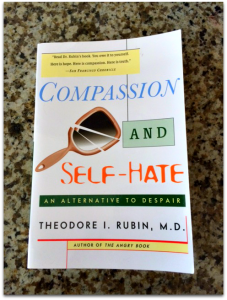 Charity begins at home, so Week 1 is about being kind to yourself. Because this can be hard to do, I decided to reread a book that really opened my eyes on this topic. Not only will it refresh what I learned a couple of years ago, it is definitely an act of kindness towards myself!


 Following Seas
You must be logged in to post a comment.