Kindness Challenge|Week 5: Choosing Kindness

Kindness_ContagiousREV

Week #5 of the Kindness Challenge was “choosing kindness” and what better contagion is there?

If only positivity could spread as quickly as negative things like gossip and poison ivy!

We see this every day on the Internet when the haters troll others with their venom. While we don’t have to agree on everything, mutual respect should be the standard. Unfortunately, this isn’t the case and the level of nastiness appears to be growing.

Kindness is a great antidote to all of the hostility in the world today, so choosing kindness is a way of rejecting the anger and offering goodwill instead.


One of the options Niki proposed was to choose someone you normally have difficulty showing kindness to and do it anyway.

An opportunity happened to avail itself with someone who I maintain a healthy distance from. This person is my ex-husband. 

We were married for 23 years following a nine-year courtship. Thirty-two years is a long time to spend with someone. We had three wonderful children together, but I’m still sad that he never tried to conquer the addiction that destroyed our family and his life.

He recently spent two and a half weeks in the hospital as his health is declining. Along with his sisters and our son, I pitched in to take care of things that needed to be done during his hospital stay.

I was sorry to see the condition of my former home. I always worked hard to keep it clean and organized, but it’s no longer that way. Just as he has neglected his health the house is also in disrepair.

I spent two days cleaning up and an additional afternoon helping my son cut and rake the yard. 

I did this for several reasons:

  1. For me – Because so much of the situation was and is out of my control, I wanted to do something positive that was within my control. 
  2. For him – I wanted to show my ex that even though he apparently doesn’t think much of himself, his family still cares.
  3. For my children – I believe that as a parent we lead by example. I want them to show caring and empathy to others, even when it’s difficult. 
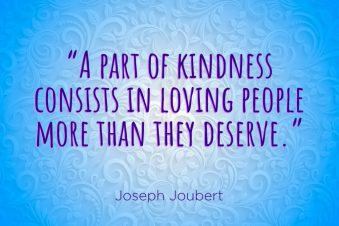
RD_Kindness-Quote

Credit: Readers Digest

It’s easy to be nice to people who treat you well. But, what about those folks who don’t?

It might be a rude customer or that guy who cut you off in traffic. 

It could be a family member or friend who would rather judge you than actively listen and consider your feelings along with theirs.

Relationships are a 50/50 proposition with half of the responsibility falling to ourselves. I tried to convince my husband that he needed help and that I would support those efforts. 

Since I couldn’t control his drinking, I believed that this was my 50 percent. However, I was weak and enabled his habit. Perhaps if I had been stronger and taken drastic measures early on it might have made a difference. I guess I’ll never know.

The following quote rings true in my mind: 
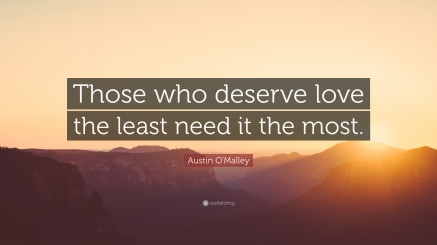
Those who deserve love the least need it the most. Austin O'Malley


People who don’t like themselves have difficulty getting along with others.

In order to offer love, empathy, and understanding we must first offer it to ourselves. 

This is what I’ve learned and worked on over the past decade. 

It doesn’t mean I excuse his behavior and the terrible losses we suffered as a family. It just means that I recognize the limitations of his humanity and the fact that we all have them, myself included.

Kindness creates an opportunity for compassion and healing, for ourselves and others. Our world needs a lot more of both, so the choice is clear.


Kindness Challenge|Week 5: Choosing Kindness

Weekend Coffee Share | Compassion

giulia-bertelli-94235If we were having coffee this weekend I’d ask you whether you think our world could use more compassion.

I certainly do. 

I’m amazed daily by reports of abuse and neglect, particularly against the most helpless in our societies. 

Compassion is a feeling of deep sympathy for someone who is stricken by misfortune, with a desire to alleviate the suffering.

Regardless of whether that person is you or someone else, three things are necessary for compassion:

  1. You must recognize the suffering
  2. You must feel moved and want to help
  3. You realize the common humanity in suffering

Recognize suffering

This one seems simple enough; we easily recognize when someone else is hurting. But, sometimes we don’t recognize it in ourselves. At times we confuse sadness and anger when they can be one and the same. 

This was something I discovered after enduring a long-term, verbally abusive marriage. I was angry at the way my spouse treated me, but didn’t realize the feelings of outrage were interlaced with great sadness. 

With some therapy and a lot of helpful books, I was able to develop a better awareness of my own feelings and how they dictated my behavior. I learned about Emotional Intelligence (EI), which is the capacity to be aware of, control, and express one’s emotions, and to handle interpersonal relationships carefully and with sensitivity.

It’s taken some work, but I score better today on EI measurements. Also known as emotional quotient (EQ), Justin Bariso, author of EQ Applied, researched for two years what emotional intelligence looks like. He composed a list of 13 signs of high EI. It’s an easy read in case you’re wondering how many you possess.

Feel empathy

This is easy for me when it comes to other people. I’ve always been empathetic and sometimes to my own detriment. This is a hallmark of codependence; putting other people’s needs first because you feel so bad for them. But, what about me?

Unfortunately, I didn’t apply this to myself. Instead, I’d listen to my inner critic, which is always quick to point out weaknesses and failures. Compassion was something I saved for others, not realizing how much I needed it, myself.

Realize normal vs undue suffering

This one is a bit more complicated. Yes, everyone suffers at times. But, at the hands of an abuser, you mistakenly think that you deserve the pain; that you’ve done something to warrant the criticism and put-downs. Essentially, I could look at other abused people and feel sorry for them, but not myself. 

It’s a strange concept now that I’ve healed from those years of malicious treatment. If only I had cared for myself back then the way that I do today. I would’ve salvaged so much time and self-esteem. However, I’m grateful that I got out of that toxic environment with a much better appreciation for myself.


I still have moments where I doubt my abilities. But, I recognize this as a human condition that everyone feels at times. 

The difference now is that I’m aware when those feelings strike.  I’ve learned to counter the fear and doubt and use positive self-talk.  

I’ve learned to treat myself the way that I’d treat a loved one; with care and compassion. I focus on my strengths and allow for the weaknesses. If I fail at something I encourage myself to try again. 

Because of all that I’ve learned, I’m able to be my own best friend. And that makes me a better friend to others! 


Revised & reposted from 2017

Gratitude Journal – Prompt #10

fingers-crossed

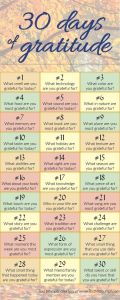
30 Days of GratitudeWhat taste are you grateful for today?

I feel inclined to use a metaphor for Day #10 in the 30 Days of Gratitude  prompts. The word “taste” implies the flavor of something perceived by the mouth or tongue (i.e.taste buds.) 

However, after carefully tracking Hurricane Matthew for several days and hearing that my family in Florida came through safely and with minimal damage, I’m grateful for the “taste of good luck.”

Is there such a thing? I’ve heard of the taste of success, so why not?

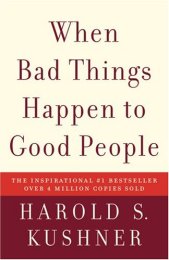
Many people rely on religion and prayer in the hope of achieving a desired result. Faith offers strength and sustenance to those who believe that all things happen for a reason. However, after reading When Bad Things Happen To Good People my views changed a bit. 

when-bad-things

This book was written in 1981 by the Conservative rabbi Harold Kushner and dedicated to his young son who died from progeria, an incurable genetic disease. In this book Kushner addresses the conundrum of why an omnipotent and loving God allows so much suffering in the world, particularly by good and decent people.

His answer to this philosophical question is that God does his best and is with us through our suffering, but isn’t fully able to prevent it. 

And that’s where luck comes in.


Now, I realize that many people of faith won’t accept this analysis. But, it brought great comfort to me in 1983, at a time when I doubted God’s love. Yes, the book questions his omnipotence, but offers an explanation that makes total sense to me. In exchange for absolute control, he offers us free will, to make wise choices and repudiate sin. And sometimes, bad things are simply random events that do happen to good people.

God doesn’t pass out x number of malignant tumors each month or hand pick certain children to die in a bus crash, while others survive. He waits alongside us, to support and lift us in our times of grief and despair. That’s a God I can believe in.

While I’m grateful that my own family came through safely, my heart aches for the people in Haiti and the other Caribbean countries. They live in poverty on their best days. The devastation that they’re facing is unimaginable and the death toll is over 300. Here in the States, 32 people died and property damage is estimated at $6 billion.

In an effort to show my gratitude for the minimal effects Hurricane Matthew had on my loved ones, I’m going to donate something for those suffering the greatest. I can’t give as much as some people, but I can give something

Let’s all think about what taste we’re grateful for today and if you’d like to help the victims of Hurricane Matthew, you can donate here.

Carpe diem!