Many of us affected by Hurricane Irma are still waiting for water and electricity, but grateful to be alive.
The temperature forecast for today is 88 degrees. Right now I’m sitting outside in the shade enjoying a pleasant breeze.
Being without running water is a new experience for me. I’m not enjoying it so far.
Thankfully there’s a pool that provides us water to flush the toilets and an opportunity to cool down from the day’s heat.
I know there are tens of thousands of people across Florida waiting for their lives to be restored. Schools and businesses remain closed.
All we can do is wait. But, it’s important to reflect on the citizens living in poverty on the Caribbean Islands. Or people who lack clean water in other parts of the world. Those who live their entire lives without electricity.
All these things we take for granted, without a second thought.
Be aware today when you turn on the faucet or adjust the thermostat, that many people never know those luxuries.
We here in Florida will eventually get ours back. But so many live in extreme poverty in a world where there is so much excess.
While we can’t solve all these issues for all the people, it’s important to be aware that inequality on all levels exists. And then do what we can to change that.
It’s also important to count our blessings and be grateful for the resources to overcome our hardships. Resources that aren’t available to everyone.
I know Florida Power & Light is working diligently to restore service, as well as the water company.
In the meantime, I’ll conserve my battery by utilizing pen and paper…and daylight!
A mind always employed is always happy. This is the true secret, the grand recipe, for felicity. ~Thomas Jefferson
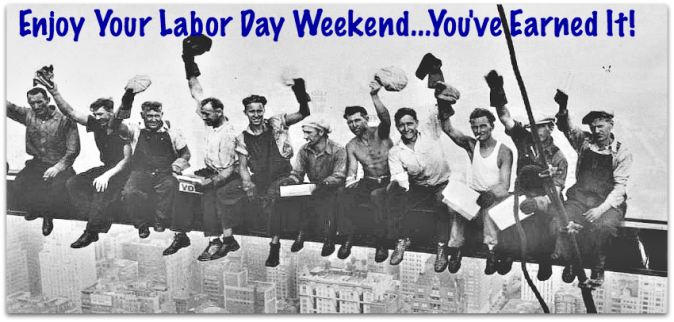
In 1893 workers for the Pullman Railroad Car Company went on strike to protest having their wages lowered while their rents remained the same amount. President Grover Cleveland called in the military and violence erupted resulting in 30 deaths, 57 injuries, and 80M dollars in property damage. To appease the workers, President Cleveland hurried members of Congress to make Labor Day a federal holiday in 1894. Twenty-three years later the Adamson Act would establish the eight-hour workday and forty hour work week that became the standard here in the United States.
As of May 2015 retail salespeople and cashiers account for the largest segment of the labor force. Despite low wages, these workers are required to put in long hours as big sales are now tied to national holidays such as Labor Day and Black Friday. So much for having the day off.
Wearing white after Labor Day has long been a fashion faux pas, but historians believe it has more to do with status. In the early 20th century white was the chosen color for wealthy people who could afford to travel to warmer climates. Photos from the 1930s show working people in dark, drab clothing, while the more affluent wore white linen suits and Panama hats.
If we were having coffee I’d want to discuss how the world got another big dose of hate this past week with Charlottesville on August 11/12 and again in Barcelona on August 17.
Less than a week apart, these horrific events always leave me feeling sick and wondering if we ever truly recover. “We” being the vast majority of the human race who reject hatred and those who espouse it.
Sure, we’ll mourn the dead, pray for the injured, and clean up the debris. We’ll leave flowers, flags, and stuffed animals at the site of the massacre.
We’ll stand in solidarity with our candles to promote love and peace. And these are all necessary gestures to begin the healing process and restore a sense of normalcy back into our world.
But, can we really recover or feel hopeful knowing that it’s just a matter of time until the next terror attack?
I’m not sure, but Joan Baez said that “action is the antidote to despair.” And I agree.
Doing something always feels better than doing nothing. The sense of helplessness is overwhelming and often prevents us from taking any action.
So, what is that something?
Well, one way is to share news and articles that can educate and enlighten us regarding the problems we face. There’s a lot of (dare I say it) fake news out there.
We have to be careful regarding who our sources are. Of course, there are right and left-leaning outlets, but I’m talking about those who have established reputations versus those who don’t.
Other options for anyone wanting to lessen their feelings of despair come from the Southern Poverty Law Center who recently posted 10 ways to fight hate.
Regardless of what avenues we choose, we must do them in the spirit of compassion and understanding. I know that’s a very tall order and one I grapple with all the time. My first reaction, when faced with opposing opinions and ideologies, is pretty negative.
Obviously, many people struggle with these kinds of emotions. However, I don’t believe we can win the war on hate with hate.
The following article and information explain further.
Credit: Teresa Crawford/AP
It’s the story of Christian Picciolini, a former skinhead who renounced hisrelationship with the neo-Nazi movement in 1996.
He co-foundedLife After Hate, whose mission statement says that they’re dedicated to inspiring individuals to a place of compassion and forgiveness, for themselves and for all people.
As a “lost and lonely” teenager, Christian was recruited by a white nationalist organization in the late 80s. He became the leader of a Chicago area group by age 16.
The birth of his first child when he turned 19 was the catalyst for breaking ties with the white supremacists, which occurred several years later.
He understands how young people fall prey to these types of hate-mongers.
Christian knows from his own experience that the youngsters are searching for three fundamental human needs: identity, community, and a sense of purpose. Those who don’t find this are the ones targeted by the hate groups.
You can walk into any high school and find those marginalized kids who’ve been bullied and/or dismissed by the majority.
They’re not accepted into the various cliques. They’re not good-looking enough, or athletically inclined, or smart enough.
They wear the wrong clothes and live in the wrong neighborhood. They may speak differently or be the wrong color.
That sense of rejection spawns feelings of worthlessness that eventually grow into anger. Left unchecked the anger swells into full-blown hate. Some will turn to drugs and alcohol. Others to crime.
Most will suffer in silence, turning their hate inward. But, some will lash out at others and seek retribution through any channel or group that offers them a feeling of security.
In the short video below, Christian tells the story of how, with the right approach and attitude, there can be life after hate. That approach includes compassion and communication with those we don’t understand.
There’s simply no room for hate when our platform is about acceptance and equal rights.


 Following Seas
You must be logged in to post a comment.